
20/10/2026 18:58
Can Others Reuse Your Demo? YouTube License Choices for Cambodian Stencil Workshops

A useful stencil demonstration can travel beyond the workshop that filmed it. A decorating teacher might want to include part of it in a lesson, while a reseller might simply want to share the original video link. Those requests sound similar, but they require different decisions. For a Cambodian workshop promoting custom stencils, the practical question is whether the footage should become reusable material or remain a demonstration that the business distributes through its own channel. Decide this before handing the video to a marketing assistant or considering an SMM panel service. This workflow connects that decision to the actual footage, the intended audience and the promotion instructions.
1. Define what you want people to do with the demonstration
Start with a concrete outcome. Perhaps viewers should understand how to lift a stencil without smearing paint, then ask the workshop about a suitable pattern. Alternatively, the workshop may want teachers to incorporate the demonstration into their own learning materials. Write that outcome in one sentence before choosing a license. A request to help customers understand a technique does not automatically mean the owner wants other businesses to edit and redistribute the footage.
Consider a hypothetical workshop in Phnom Penh filming a reusable border stencil on a sample board. Its owner welcomes customers sharing the video link but wants to discuss any use inside a reseller's advertisement. That preference points toward retaining the default license and handling reuse requests individually. A different hypothetical workshop deliberately creating an open teaching resource might prefer broader reuse. Neither decision establishes that the video will attract enquiries; it establishes how the workshop intends to make the material available.
2. Understand the two choices without treating them as promotion settings
YouTube's official license guide identifies two upload options: the Standard YouTube license, which is the default, and Creative Commons Attribution. The latter allows reuse under CC BY terms and requires the uploaded material to be eligible for that license. YouTube also says a video with a Content ID claim cannot be marked Creative Commons Attribution.
Creative Commons explains that CC BY permits redistribution and adaptation, including commercial use, subject to its conditions. Attribution does not mean the creator endorses the reuse. This makes the choice broader than permission for one friendly teacher to show a technique.
For the workshop, translate those differences into an editorial decision. Would the owner be comfortable seeing an adapted demonstration in another business's commercial material, provided the applicable terms are followed? If that possibility is unwelcome, do not select Creative Commons merely because the name sounds cooperative. The license menu is not a setting for Cambodian targeting, advertising delivery or improved search placement.
3. Review the ingredients of the finished video
Watch the final export and build a short ingredient list: filmed footage, stencil artwork, narration, music, inserted photographs and any identifiable people. Beside each item, record who supplied it and where the relevant permission is documented. An assistant should be able to distinguish material created for this project from material borrowed to make the edit more attractive. Keep unresolved items visible instead of treating an empty field as approval.
In a hypothetical example, the owner filmed the painting sequence, but the opening image came from a customer's renovation project and the soundtrack came from a subscription library. Those items need their own review before broad reuse is offered. Permission to include something in one workshop video should not be assumed to cover licensing it for other people's adaptations. Creative Commons also notes that privacy, publicity and other rights may require separate consideration. A cleaner educational export may be easier to assess than an advertisement assembled from many contributors.
4. Separate the teaching version from the sales version
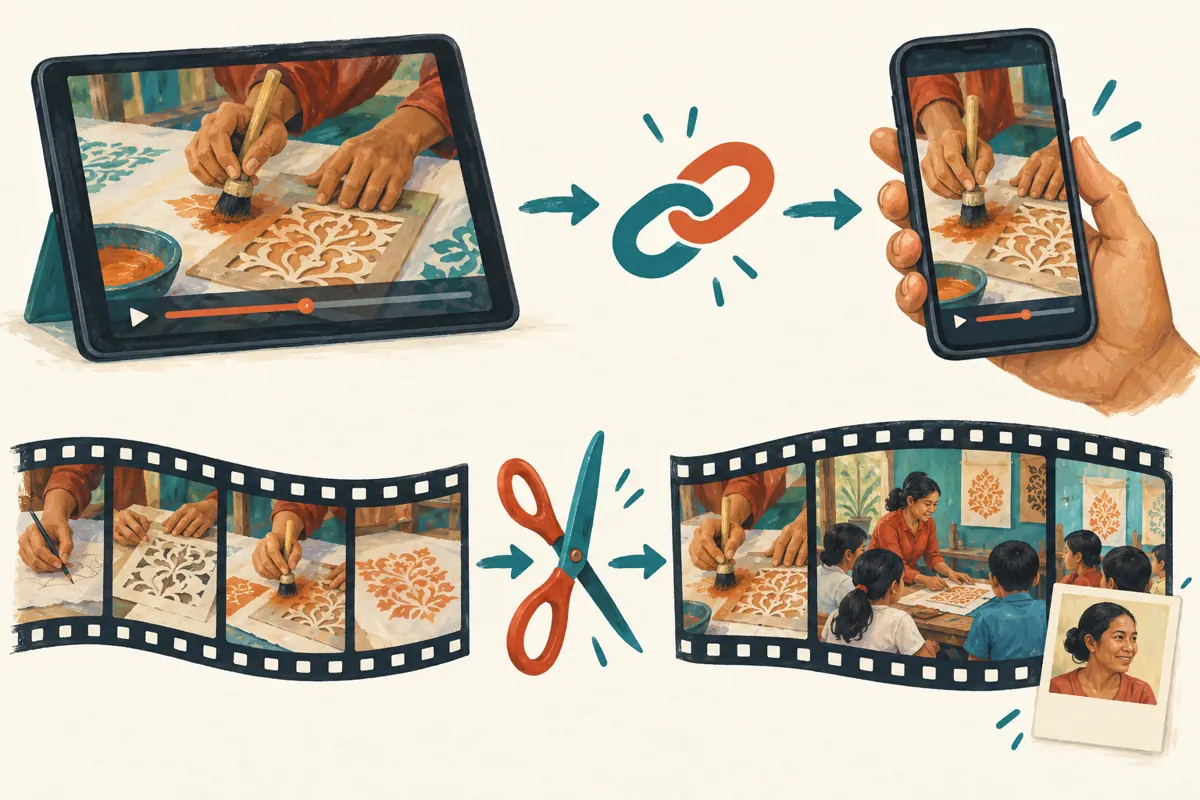
A practical production choice is to create distinct edits with distinct purposes. The teaching version might show positioning, light paint application and careful stencil removal on an anonymous sample board. The sales version might include the workshop's current product selection, a customer commission and an invitation to request a quote. Decide the license for each finished edit independently, based on its contents and intended use.
This approach is especially useful when promoting a workshop serving different Cambodian towns. A general technique lesson can remain useful while delivery arrangements and available patterns change. Keep temporary offers out of a resource intended for long reuse. For example, demonstrate how the border repeats without stating that every pattern is available for immediate collection. Assign clear internal filenames and record which export became which public video. The filenames are an organisational aid, not a substitute for checking the actual upload.

5. Make the selection on the correct upload
YouTube's documented desktop route for an existing upload is YouTube Studio, Content, then the video's title or thumbnail. On its Details page, open Show more and find License. The Creative Commons option can also be selected during upload. Save any changes and reopen the video's details to confirm the intended selection.
Before touching that menu, compare the thumbnail, opening frames and full video with the approved export. Similar demonstrations can be surprisingly easy to confuse: the workshop may have one lesson using a simple geometric border and another featuring commissioned artwork. Record the video URL, selected license, review date and person responsible in the production note.
Give the marketing assistant an explicit handoff: which video to distribute, which version was reviewed and whom to contact about reuse questions. Do not leave the assistant to infer permission from a folder called finished. If the owner has not resolved the rights review, pause distribution of the uncertain edit and finish that decision first.
6. Provide attribution information that survives a handoff
For an intentionally reusable resource, prepare a compact credit record containing the work's title, creator, source URL and applicable license link. Explain any changes when adapting someone else's material, as required by the relevant terms. Creative Commons cautions against attribution that implies endorsement.
A hypothetical workshop could keep a note identifying its stencil-lifting lesson, its chosen public creator name and the original watch-page address. A teacher preparing an adaptation could then identify the source accurately instead of guessing from a shortened channel name. Use real links in the completed record; placeholders belong only in drafts.
Make the record understandable to the people handling the work. If the owner approves content in Khmer while an editor maintains English production notes, have someone check that both versions describe the same permission. Keep licensing information separate from product availability. A credit should not accidentally imply that the workshop supplied every tool or approved every claim in someone else's lesson.
7. Distinguish a shared link from reused footage
Ask anyone requesting the video what they actually plan to do. Sending the original watch-page link, incorporating a downloaded segment into a new edit and placing footage inside a reseller advertisement are different workflows. Request a description of the proposed output, where it will appear and whether the footage will change. This short conversation often resolves the ambiguity behind the phrase share your video.
For example, a hypothetical decorating supplier in Battambang might initially ask for the file when a link to the workshop's full demonstration would meet its needs. Another partner may genuinely need an edited teaching sequence. Route that second request through the applicable license or a specific permission discussion. Do not send the master file simply because the requester says it will provide exposure.
Keep customer instructions with the original demonstration clear enough to remain useful when its link is forwarded. State which stencil is shown and what information a buyer should provide when asking about a different size. This improves the handoff without making claims about how widely the link will circulate.
8. Review an SMM service independently of the license
The supplied smm-asian.com catalogue includes the exact service name YouTube Social Shares from Twitter. Its description is empty. The name identifies a listed sharing-related offering, but it does not establish how distribution happens, who sees it, whether anyone clicks or whether viewers are in Cambodia. Obtain the current service details before making a decision; do not fill those gaps with assumptions.
Ask whether the proposed activity distributes the original link, republishes footage or uses another method. If that cannot be explained clearly, the request is not ready. A permissive video license does not settle whether a promotion method complies with platform rules. YouTube prohibits artificial inflation of engagement and warns that actions by hired promoters can affect the channel.
Purchased engagement is not evidence of genuine interest, sales, ad delivery or Cambodian users. Keep any service delivery record separate from actual customer enquiries. A useful business observation would be that a customer asked whether the demonstrated border suits a particular wall. A panel status or changed counter cannot establish that understanding. Avoid services whose methods violate platform policies.
9. Avoid mistakes that create lasting confusion
The most consequential mistake is treating Creative Commons as a temporary experiment that can later be completely undone. Creative Commons explains that licenses already granted are not revoked for people complying with their terms merely because the creator changes direction. Decide deliberately before release.
Other mistakes are easier to prevent during review. Do not assume a music subscription includes every onward licensing permission. Do not use a customer's finished wall as decorative background without considering the permission for that use. Do not tell a partner that credit alone resolves every rights question. When something is uncertain, replace it, clarify the permission or keep the draft out of circulation.
Also avoid turning a sample into a product promise. A clean stencil impression on a prepared board does not demonstrate the same result on every wall. Explain what surface and materials the workshop actually used. Clear teaching protects the usefulness of the video when someone encounters it outside the original sales conversation.
10. Review what happened after distribution
Set a practical review point after the workshop has had time to receive questions. Read enquiries for misunderstandings: did viewers think the stencil itself was free, mistake the sample dimensions for a custom order or assume a reseller was the manufacturer? Use those questions to improve the next demonstration and the accompanying explanation. Keep examples anonymous in the internal review.
If you find a reused version, record its location and the specific concern before responding. Separate an inaccurate product statement from missing credit or another permission issue. A calm, precise request is more useful than accusing every unfamiliar upload of theft without examining the license and circumstances.
Preserve the approved export, permission notes and release decision together. When a colleague prepares the next campaign, those records explain why one demonstration was offered for reuse and another was distributed only through its original link. The process should help the workshop make the next decision accurately, without relying on memory or a promotion provider's interpretation.

Frequently asked questions
Must I choose Creative Commons so customers can share my video link?
No. Sharing the original watch-page link is different from granting permission to adapt or redistribute the footage. Decide whether customers need the original demonstration or whether a collaborator actually needs material for a new production. Keep the request specific before changing the license.
Can I choose Creative Commons for only the technique lesson?
Yes, you can make a separate decision for that upload, provided its contents are eligible. Keep the lesson and sales edit clearly identified. Review the lesson's audio, images and artwork too; removing the sales message alone does not resolve permissions for everything included.
Does paying a videographer mean the workshop can license everything freely?
Do not assume that payment answers the question. Check the agreement and any third-party assets included in the finished production. Ask specifically whether the intended reuse licensing is covered. If the agreement is unclear, resolve that issue before selecting a broader license.
What if another business adapts the demonstration?
First check the license under which the material was released and what the other business actually did. Commercial adaptation can fall within CC BY permissions. Assess credit, claims of endorsement and other relevant conditions separately. Your dislike of the context does not itself establish a violation.
Should a sharing service receive the original video file?
Only consider supplying a file after the proposed use is clear and appropriately authorised. A service described as sharing may only need a public link, but the supplied catalogue description does not confirm its requirements. Ask for documented inputs and methods instead of sending files speculatively.
Explore the current service catalogue, create an account, or ask a specific question through support tickets.
- YouTube Help: License types on YouTube
- Creative Commons: Attribution 3.0 Unported license deed
- Creative Commons: Frequently Asked Questions
- YouTube Help: Fake engagement policy
Prepared with AI assistance. Illustrations explain the workflow and do not represent customer results.