
22/10/2026 11:32
Replay or Confusion? YouTube Retention Checks for Cambodian Garden-Supply Shops
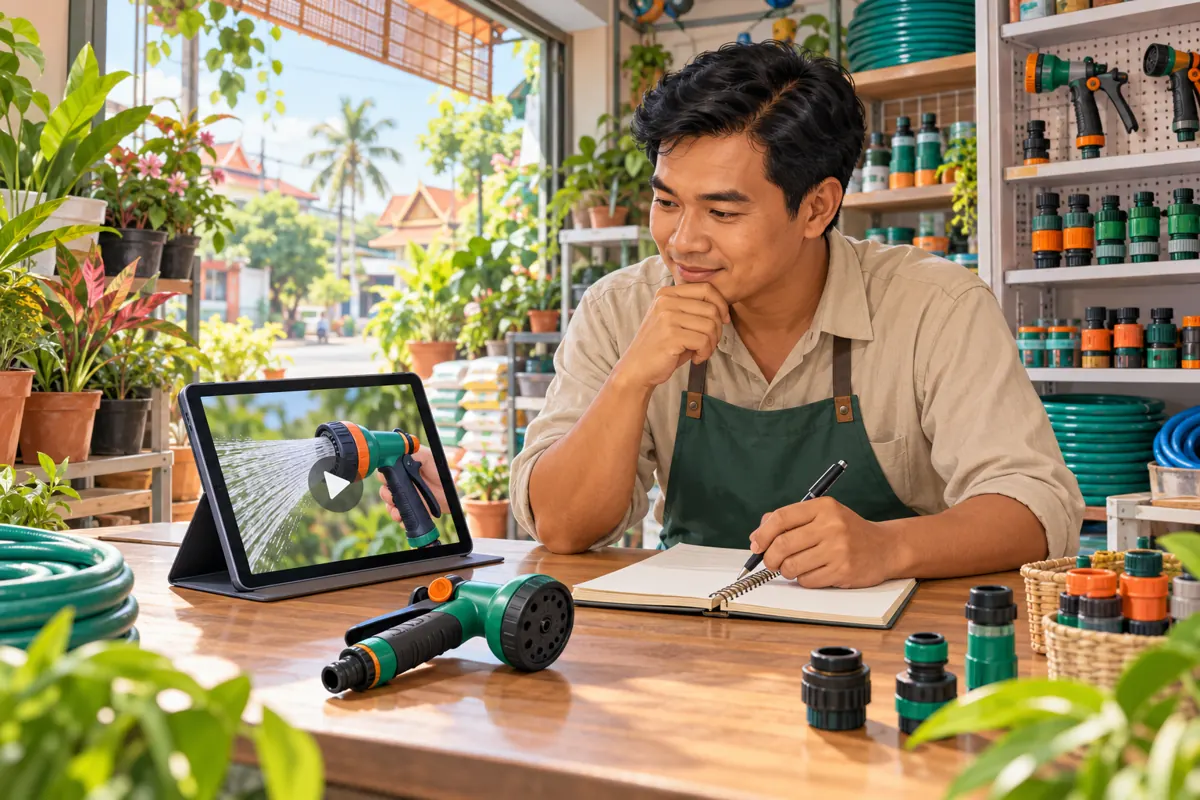
A viewer replaying a watering-nozzle demonstration might admire the spray pattern—or struggle to see which ring the presenter turned. That difference matters for a Cambodian garden-supply shop deciding what to film next. A useful review connects viewing patterns with the actual explanation, then checks whether someone can understand the product. This workflow helps shop owners and social media assistants inspect one YouTube demonstration, choose a focused improvement and prepare honest promotion. It also explains why an SMM panel delivery record cannot establish that viewers understood the nozzle, live in Cambodia or intend to buy it.
1. Start with one buying question
Choose a question narrow enough to answer visibly. For this article, consider a hypothetical garden-supply shop in Battambang whose customers ask how to change a hose nozzle from a concentrated stream to a gentler spray. The demonstration should show the control, the adjustment and the resulting water pattern. A general tour of every gardening accessory would make this particular question harder to evaluate.
Write a plain success statement before opening analytics: after watching, a person should be able to identify the selector and explain how the demonstrated setting changes the spray. Keep compatibility separate. Recognising a control does not establish that the nozzle fits the buyer’s hose connection. This distinction gives the shop two useful next steps: improve the explanation if the control is unclear, or prepare a separate fitting guide if compatibility is the unresolved question.
2. Find the report without rushing the interpretation
YouTube’s official guidance places audience retention at the individual video level. In YouTube Studio, open Content, choose the video’s Analytics, then look under Overview or Engagement. Data typically takes one to two days to process. Highlighted key moments require a video of at least 60 seconds and at least 100 views, and appear only when detected.
Record the video link, review date and selected reporting period. Then watch the demonstration once without looking at the graph. Note where the presenter introduces the nozzle, touches the selector, changes the setting and shows the result. This independent viewing pass prevents a dramatic-looking graph feature from becoming the only thing the reviewer notices.
If the report is unavailable, write that down and continue with a manual clarity review. Do not stretch a useful short explanation or pursue artificial views simply to qualify for highlighted moments.
3. Connect a viewing pattern to the exact action
YouTube describes spikes as moments watched again or shared; they can also indicate unclear content. Dips can reflect skipping or leaving. The intro measure concerns viewers still watching after the first 30 seconds. These signals identify places to inspect, rather than supplying a complete explanation of viewers’ intentions.
For each place worth reviewing, make a short observation note: what is on screen, what is being said and what the viewer needs to understand. In the hypothetical nozzle demonstration, the presenter might say “turn this” while a hand covers both the selector and the trigger. That is an observable communication problem, regardless of whether a spike appears there.
Use tentative language for the interpretation. Write “the selector may be difficult to identify,” then propose a close-up. Avoid “customers love this feature” unless separate, genuine feedback supports that statement. A timestamp is a useful pointer; it is not a customer interview.
4. Check the promise before shortening the opening
Read the title and inspect the thumbnail beside the opening scene. If the promise is changing the spray setting, an extended shop introduction delays the answer. A more direct opening could show the nozzle and name the control immediately. The business can still introduce itself briefly once the viewer understands what the demonstration will cover.
Do not remove necessary context just to make the beginning faster. A close-up of moving fingers is unhelpful if viewers cannot tell which product they are seeing. Show the whole nozzle first, then move closer to the relevant part. For Khmer-speaking customers, use familiar spoken wording and keep any model designation consistent with the packaging.
Check the spoken claim too. A demonstration using the shop’s water supply does not establish identical results at every home. Describe the setting shown without promising universal pressure, reach or suitability for every plant.
5. Refilm the difficult action with continuity
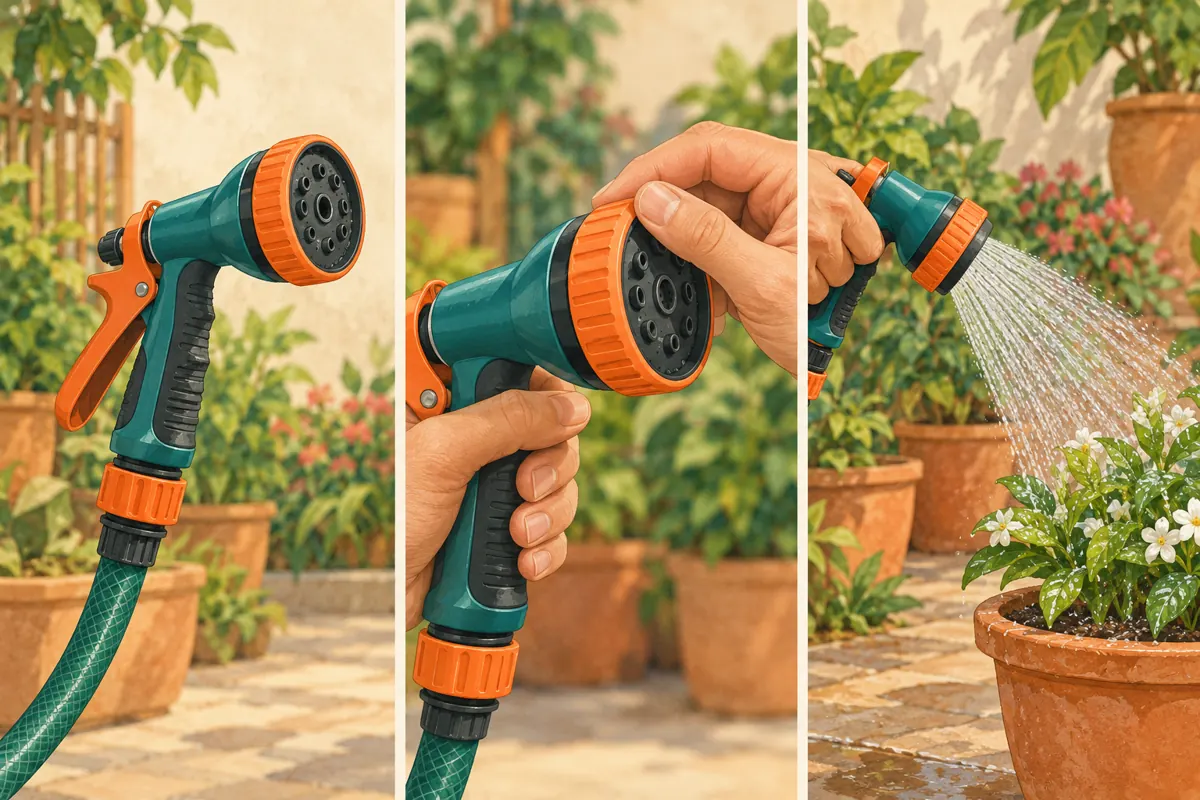
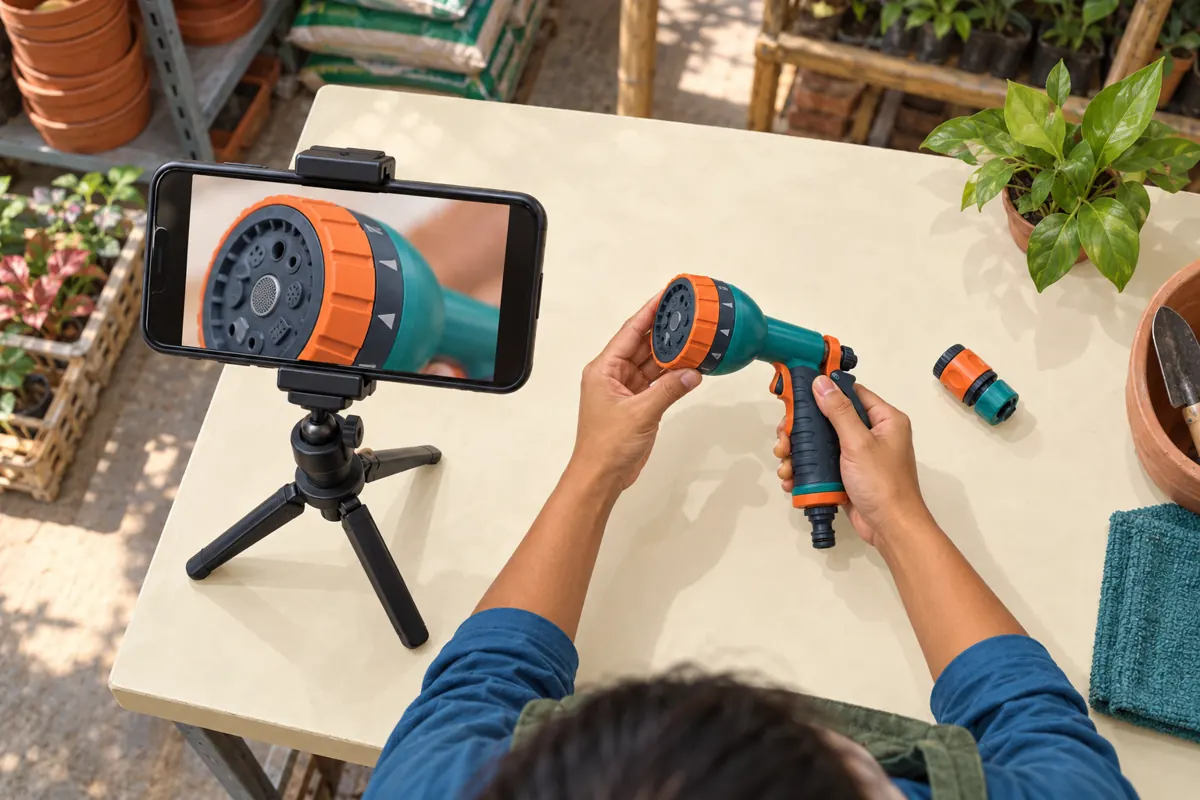
Prepare the nozzle, hose connection and background before recording. Position the camera so the selector remains visible throughout the movement. Avoid cutting from one hand position to another at the precise moment the control changes. A continuous view helps people connect the action with the result instead of guessing what happened between shots.
In a hypothetical revision, the presenter first points to the selector without covering it, demonstrates the adjustment according to the product’s instructions, and then shows the water pattern. Keep the same nozzle visible across the sequence. If another model appears, explain the switch rather than allowing colour or shape similarity to imply identical operation.
Review the footage on an ordinary phone before approving it. Check whether glare hides the markings, running water overwhelms speech or the hand blocks the control. These checks address practical comprehension; they do not require a promised improvement in retention.
6. Use a teach-back check to investigate uncertainty
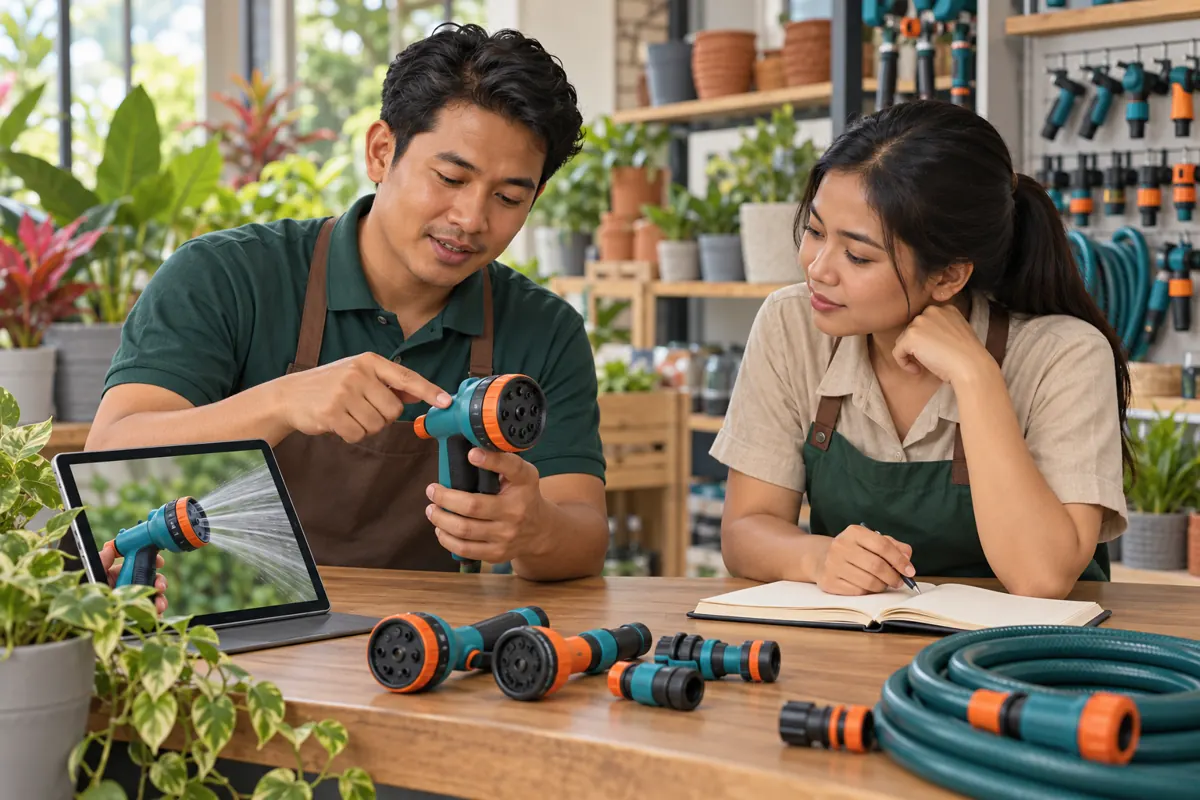
Ask a colleague unfamiliar with the recording to watch it without coaching. Afterwards, ask them to point to the control on the physical nozzle and describe what the presenter changed. Keep the task simple and follow the product’s handling instructions. The aim is to discover what the explanation communicates, not to test the colleague’s gardening knowledge.
Avoid leading questions such as “you understood the selector, right?” Instead ask, “Which part would you adjust, and what would you expect to change?” Record the response in ordinary language. If the colleague points to the trigger, the next filming decision is clearer than it would be from a graph alone.
Treat this as a small editorial check, not representative market research. One person’s understanding cannot stand for all Cambodian buyers. Their hesitation can nevertheless expose a hidden step that the presenter, through familiarity, no longer notices.
7. Choose one improvement and document the reason
Create a compact revision note containing the observed problem, proposed change and question to revisit. For example: “The hand covers the selector; film a closer continuous view; check whether an unfamiliar viewer can identify the control.” This gives the camera operator a concrete assignment and keeps the review from turning into an unfocused request to make everything more engaging.
Choose the first change according to the evidence. If the opening promises a fitting guide but delivers a spray demonstration, correct the promise. If the action is hidden, improve the shot. If the control is visible but the explanation uses unfamiliar terminology, revise the wording. Several problems may exist, but one clear priority makes the next production session manageable.
Keep a copy of the original script and the revision note. That record helps the team understand why the new demonstration differs, especially when filming and social media work are handled by different people.
8. Review SMM catalogue entries against the actual task
The supplied catalogue includes the exact service name “YouTube - Social Share ~ Speed 1000/days ~ 90 days Auto Refill Protection”. Its description is empty. The name identifies a share-related offering, but does not explain the delivery method, recipient relevance or how its claims are verified. It provides no basis for assuming Cambodian viewers, useful feedback or comprehension of the demonstration.
A shop seeking to understand confusion should therefore recognise a mismatch: a share-related catalogue entry is not a usability study. Ask for documented delivery methods before considering any promotion supplier, and check platform rules. YouTube prohibits artificial engagement, and a hired promoter’s actions can affect the channel. Reject methods that inflate metrics.
Purchased engagement is not evidence of genuine interest, sales, ad delivery or Cambodian users. For this task, spending effort on a clearer demonstration and voluntary feedback offers a more direct way to investigate the unanswered question.
9. Promote the answer with accurate context
Once the explanation is clear, share it where the question is relevant and posting is permitted. A shop could send the link in response to an actual enquiry about the selector, or include it in an appropriate product information post. Introduce the specific problem the video answers. Do not present it as a complete compatibility guide if it covers only spray adjustment.
Make the next step equally specific: buyers with fitting questions can provide the nozzle model and a clear photograph of their hose connector through the shop’s usual enquiry route. Request only information needed to answer that question. Avoid asking people to post addresses or payment details publicly.
Keep claims grounded in the filmed product. The thumbnail, caption and spoken explanation should refer to the same model and demonstrated action. A visually similar replacement in stock deserves a fresh check before the old demonstration is reused.
10. Evaluate the revision without inventing a result
After the revised demonstration has had time to gather usable information, repeat the review with the same question in mind. Note the reporting period and any changes in how the link was shared. A new audience, different product or different promotion context can affect what you observe, so two uploads do not automatically form a controlled experiment.
Keep three records separate: viewing observations, comprehension feedback and business enquiries. A colleague correctly identifying the selector supports a narrow clarity finding. A buyer asking whether an adapter is included is a product enquiry. A panel status concerns service delivery. None of these records should be silently substituted for another.
Useful conclusions can be modest: “The selector is now visible throughout the movement,” or “The reviewer still confused the trigger with the selector.” Avoid announcing a sales improvement unless actual business records support it and the attribution limits are explained.
11. Avoid fixes that remove the useful information
Common mistakes include cutting every pause, treating every replay as praise and removing the final result because it looks repetitive. A pause may give viewers time to inspect the control. Repetition may be necessary to compare settings. Judge each segment by the question it answers and whether its details remain visible.
Another mistake is changing the title, script, camera angle, product and sharing approach together, then crediting one change for the outcome. Record substantial differences and keep conclusions proportionate. Finally, do not turn uncertainty into a public success story. The most valuable outcome may simply be a demonstration that staff can confidently use to answer a recurring question.
Frequently asked questions
Does a replay spike mean customers want that nozzle?
No. It does not establish purchase intent. Inspect the action and wording at that point, then seek voluntary feedback about what was clear or confusing. A genuine model or compatibility enquiry provides different information, which should be recorded separately.
What can a small Cambodian shop do without enough retention data?
Use the same content review without numerical conclusions. Check the title’s promise, watch on a phone and ask someone unfamiliar with the recording to identify the control. Document the limitations rather than buying engagement to make the report appear more useful.
Should every product demonstration be made shorter?
No. Remove unrelated introductions and unnecessary repetition, but preserve the steps needed to understand the product. A slightly longer continuous view can explain an adjustment better than a fast sequence that hides the important movement.
Can an SMM service confirm that promotion reached Cambodian buyers?
A service title or delivery status alone cannot confirm that. The supplied share-related listing has no supporting description establishing audience location or buyer relevance. Do not infer local demand, genuine interest or sales from purchased engagement.
How should a shop record a successful clarity revision?
Describe the specific evidence: the control remained visible, the narration named the correct part, and an unfamiliar reviewer could explain the action. Keep that conclusion limited to the checks performed. It is an editorial improvement, not proof of higher sales or guaranteed reach.
Explore the current service catalogue, create an account, or ask a specific question through support tickets.
Prepared with AI assistance. Illustrations explain the workflow and do not represent customer results.